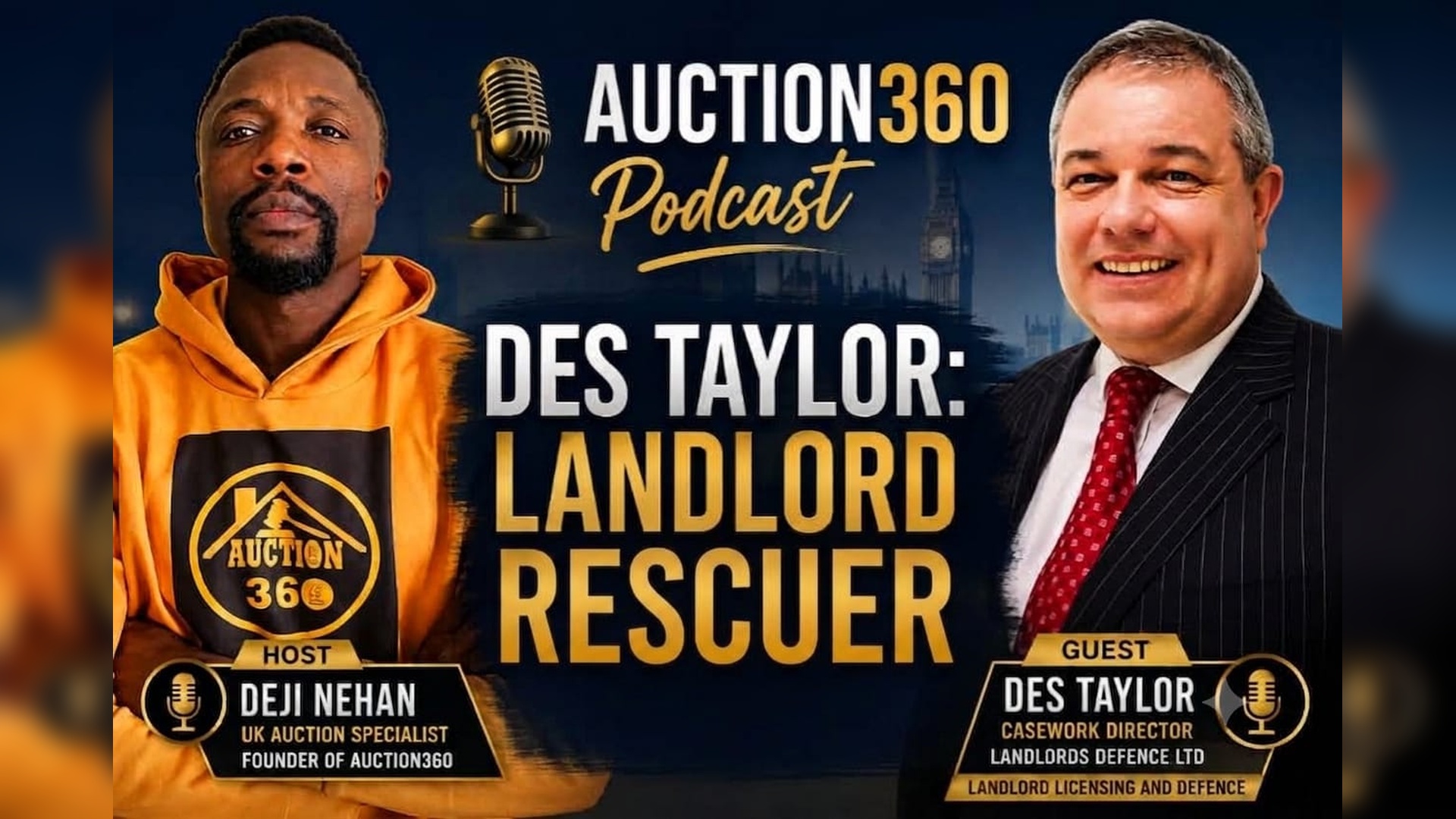
Des Taylor: Landlord Rescuer Pt2
Des Taylor: Landlord Rescuer | Auction360 Podcast with Deji Nehan What happens when landlords find themselves facing difficult …
View More
Episode 5 · The Auction360 Podcast
Alastair Hoyne, BSc (Hons) · MLIBF · CeMAP · CPSP Chief Executive Officer – Lending
Property investment is about more than finding the right property and agreeing on the right price. How you structure the finance behind the transaction can have a major impact on your ability to complete the purchase, manage risk, preserve cash flow and make the opportunity work commercially.
In this episode of the Auction360 Podcast, host Deji Nehan, Founder of Auction360 and author of Auction Demystified, is joined by Alastair Hoyne, BSc (Hons), MLIBF, CeMAP, CPSP, Chief Executive Officer in the lending sector, for an in-depth conversation about the relationship between property deals and property finance.
What does it really take to structure property finance effectively?
Whether you're buying at auction, purchasing an investment property, undertaking a refurbishment, refinancing an existing asset or looking at development opportunities, the finance structure needs to align with the property, the investor's objectives and the overall transaction.
Deji and Alastair explore the key considerations investors and property professionals should understand before committing to a deal, including:
? Understanding different property finance options
? How lenders assess property transactions and borrowers
? Matching the right finance product to the right property strategy
? Financing auction purchases and refurbishment projects
? Understanding deposits, leverage, interest and associated costs
? Bridging finance, refinancing and exit strategies
? How financial structure can affect investment returns
?? Common financing mistakes that can create problems later
? The importance of having a realistic and credible financial plan
? Working effectively with lenders, brokers and other professionals
? What investors should consider before making an offer or bidding at auction
? How a well-planned finance structure can help investors identify and pursue viable opportunities
Who is this episode for?
This episode is particularly relevant to property investors, auction buyers, landlords, developers, aspiring investors, property professionals and anyone looking to better understand how property finance fits into the investment process.
If you've ever found a property opportunity but wondered ""How am I going to finance this?"", this conversation provides valuable insights into the questions you should be asking before proceeding.
Meet the Host
Deji Nehan
Founder – Auction360
Author – Auction Demystified
Property & Auction Specialist
Meet the Guest
Alastair Hoyne
BSc (Hons) · MLIBF · CeMAP · CPSP
Chief Executive Officer – Lending
Beyond the Deal is about looking beyond the purchase price and understanding the financial structure that can determine whether a property opportunity is workable.
Listen, learn and join the conversation.
If you find this episode valuable, like, follow/subscribe, share it with another property investor, and leave your thoughts in the comments.
What is the biggest financing consideration you think property investors often overlook?
#Auction360 #PropertyFinance #PropertyInvestment #PropertyAuctions #BridgingFinance #PropertyDevelopment #RealEstateInvesting #AuctionProperty #PropertyInvestors #MortgageFinance #PropertyFunding #AuctionDemystified #UKProperty #RealEstateFinance
"
?? 03:02 – 04:30
Alastair explains that his experience in structuring deals extends beyond traditional property finance. The key lesson is to look at the opportunity and the value that can potentially be created, rather than viewing finance simply as a way of borrowing money to purchase an asset.
?? 09:58 – 11:03
The discussion highlights the importance of considering the asset, purchase price, existing value and proposed value-add strategy. A borrower's circumstances matter, but so does the story behind the transaction and what the investor intends to achieve with the property.
?? 11:34 – 13:28
Alastair explains how specialist lending can work where a property is genuinely being purchased below its open-market value. The important point is that investors need to establish that the discount represents real underlying value, rather than simply assuming that every cheap property qualifies as a below-market-value opportunity.
?? 18:34 – 20:57
The conversation explores commercial properties such as social housing, supported living, care homes, hotels and other income-producing assets. Alastair explains how structures such as OpCo/PropCo arrangements can potentially create an investment valuation by separating the operation of a business from ownership of the property.
?? 41:32 – 44:54
One of the important financing lessons is the need to understand the lender's underwriting process before committing significant money to a transaction.
The discussion highlights a potential problem where an investor pays for a valuation, only to discover afterwards that the lender will not proceed because of other underwriting considerations.
Lesson: Understand the lender's criteria and get as much of the transaction assessed as possible before incurring unnecessary costs.
?? 45:17 – 48:30
The podcast tackles a common misconception around 100% funding and collateral.
The headline percentage of a loan does not tell the whole story. Depending on the transaction, lenders may require additional security, equity, collateral or other conditions.
The lesson is to understand exactly what “100% funding” means for the specific deal rather than relying on a headline figure.
?? 49:12 – 51:04
Alastair discusses how lending against the underlying value of an asset can potentially reduce the amount of additional assets tied up in a transaction.
This leads to a broader lesson: investors should consider how much of their existing capital and assets they are committing to one transaction, particularly when other opportunities may become available.
?? 53:25 – 55:34
This is one of the strongest practical lessons from the episode.
Before attending an auction, investors should have their finance and due diligence in place. An AIP (Agreement/Application in Principle) may not necessarily mean the funds are guaranteed for the particular property.
The speakers also discuss the danger of becoming emotionally attached to a lot and continuing to bid beyond the predetermined figure.
Set your numbers before the auction—and know when to walk away.
?? 54:36 – 56:34
The speakers use an example of a property expected to be worth significantly more after title splitting and renovation, but which ultimately sold at a price that potentially undermined the investment strategy.
The lesson is simple:
Someone else's bid does not determine the value of your investment.
Other bidders may have completely different objectives—for example, a developer may be willing to pay more because the property has strategic value to them.
?? 51:04 – 52:23 & 1:03:25 – 1:05:10
The closing section reinforces the importance of due diligence, financial discipline and long-term thinking.
Investors shouldn't assume that every apparently attractive deal must be pursued. Sometimes walking away from a transaction is part of the investment process.
The conversation also explores thinking beyond maximum leverage and considering how equity, value creation and profits can be recycled into future investments.
Connect with Alastair Hoyne:
Follow Des on social media through the links provided below:
Des Email
Des Linkedin
Des Website
Connect with Deji Nehan:
Follow Deji Nehan on social media through the links provided below:
Deji Nehan LinkedIn
Deji Nehan TikTok
Deji Nehan Instagram
Deji Nehan Facebook
Deji Nehan Youtube
Connect with Auction360:
Follow Auction360 on social media through the links provided below:
Auction360 LinkedIn
Auction360 Instagram
Auction360 Facebook
Auction360 Youtube
Auction360 Website
They should consider the property, purchase price, valuation, proposed strategy, required works, financing costs, borrower circumstances and, importantly, the intended exit strategy.
It refers to financing a property that is genuinely being acquired below its open-market value, subject to the lender's specific criteria and assessment of the transaction.
Not necessarily. The episode explains that 100% funding can involve other requirements, including additional collateral or security depending on the transaction.
The exit strategy explains how the borrowing is expected to be repaid—for example, through a sale, refinance or another planned route. It is an important part of assessing whether the overall financing structure makes sense.
An AIP or illustration may indicate that borrowing could be possible, but it does not necessarily mean that the particular property and the borrower's complete circumstances have passed the lender's underwriting requirements.
The valuation helps establish the lender's view of the property's value and therefore can influence how much they are prepared to lend.
Yes. The episode discusses situations where the income generated by a commercial property and its operating structure can influence its investment value, rather than looking solely at the bricks-and-mortar value.
It is a structure in which an operating company (OpCo) runs the business while a property company (PropCo) owns the property and leases it to the operating company. The podcast discusses how this can potentially support an investment valuation in appropriate circumstances.
Set a maximum price before the auction based on the numbers, finance costs, expected value, works and desired return. Most importantly, be prepared to stop bidding when the property exceeds that figure.
Don't focus only on finding a deal or getting the money. Understand whether the entire transaction works. The property, finance structure, costs, value-creation strategy and exit should all fit together before committing to the purchase.
Work out exactly what you need to complete inside the 28 days, then talk it through with a specialist.
Auction Finance Calculator Book A Discovery Call
Des Taylor: Landlord Rescuer | Auction360 Podcast with Deji Nehan What happens when landlords find themselves facing difficult …
View More
Des Taylor: Landlord Rescuer | Auction360 Podcast with Deji Nehan What happens when landlords find themselves facing difficult …
View More
AUCTIONS, DISTRESSED PROPERTY & THE SECRETS HIDDEN IN THE LEGAL PACK What really happens when you buy or …
View More